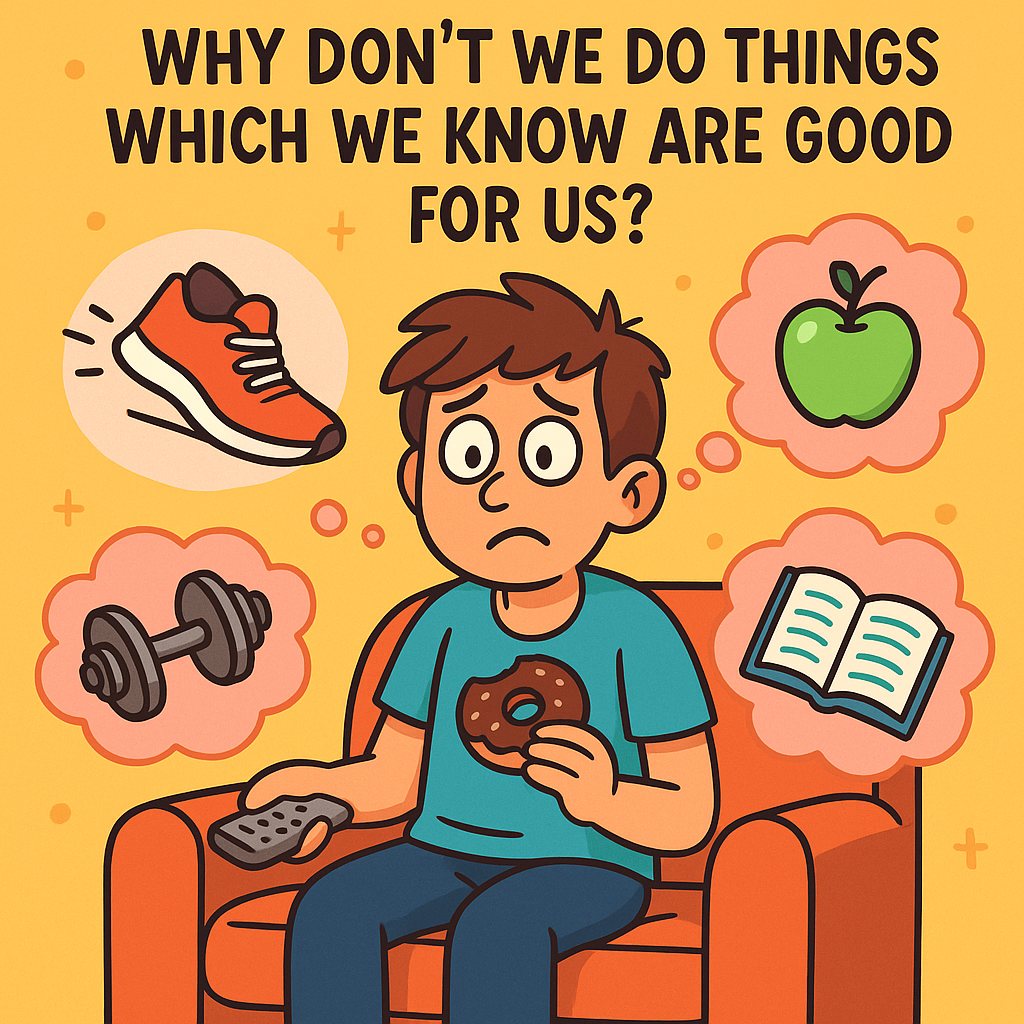
Why dont’ we do things which we know are good for us ?
An alarm goes off at 5 am! It has been proven to be the biggest tyrant in my blissful sleep! It
must be executed instantly!!! So I violently tap on snooze & go back to my dreamland… The
next day arrives with heavy guilt & self-blame! Why??? Why??? Why??? Why did I switch the
alarm off???
I had decided to run early in the morning… I dreamt of running a full marathon… I
visualized myself as the fittest version of me… I had taken a decision to go all in… I had bought
new running shoes… I had very proudly told my husband about my plans… I had done
everything… till the alarm went off! Why???
Nowadays, along with guilt and self-blame, “I’ve developed the habit of analyzing situations, as
it gives me some consolation.
Sounds familiar??? Do not worry… 99% readers fall in the same category of you and me!
So why don’t we do things which we know are healthy for us, good for us, or beneficial to us?
Why do we dive into indulgence only to reach the bottom of self-pity, guilt & self-blame? Why
don’t we grab the opportunity in time & just to regret later?
If you are finding these questions intriguing, the article is for you…
Guilt & self-blame drain energy because it stays stuck in judgment, while asking “why” turns it
into awareness. That’s progress—but don’t stop at “why didn’t I do this?” Also ask “how can I
make it easier next time?” This shifts the analysis as a form of consolation to actual growth.
There are a few layers to this deep & very human question —psychological, biological and even
philosophical.
Biological Wiring
Instant Gratification
- Our brains have evolved to prioritize short-term rewards, many “good” things today—exercise, studying, eating healthy, meditation —require effort now for rewards later,
- The brain naturally resists that as it does not conform to the concept of “Instant Gratification”. Brain and ultimately your body wants instant rewards.
SOLUTION :
Don’t fight the need for short-term rewards. Redirect it into the habits that serve your long-term goals. After doing the right thing, pause and celebrate—your brain learns to associate that habit with good feelings. Let it sink into the brain and the body.
Psychological Barriers
Barriers
- Fear & Resistance: Change feels unsafe to the subconscious mind and even to our body, even if it is rationally good. It threatens our comfort zone and this threat is felt at the physical, mental, emotional and spiritual level. It feels like letting go of our self-identity, losing a part of ourselves.
- Being overwhelmed: Big goals like “get fit” or “eat healthy” feel vague and huge, so we
- Identity Gap: If deep down we don’t see ourselves as “a healthy person” or “a disciplined person,” we self-sabotage, sometimes there lies a deeper unhealed belief that “I don’t deserve to be better”.
SOLUTION :
(a) EFT works wonders with all our emotions which feel like heavy baggage. You
can release all fears, guilt, overwhelming feelings, limiting beliefs about ourself easily with the help of EFT and that too instantly. EFT also helps in cultivating a positive belief system which in turn helps in improving your self-image in your own eyes. Self-worth is how we see ourselves, with the daily practice of EFT you tend to release all the limiting beliefs about yourself and thus helps in crossing these psychological barriers easily.
(b) Try to find the root cause for your low self-worth, which almost always lies in
our childhood. We must try and heal it.
(c) Keep your goals definite & achievable.
Practical Environment
Even with good intentions, our environment shapes actions:
- Constant availability of phone, peers not sharing the same habits, trolling on social media, foods which are not healthy but readily available through just one click, indulging in something just to be a part of an ongoing trend – all these things make “the bad choice” easier.
- Habits stick best when the environment is designed to make “the good thing” friction-free.
SOLUTION :
Keep healthy things visible, hide temptations, monitor screen time, do not get affected by trolling, and avoid the temptation of following each and every trend.
The Inner Conflict at an Anatomical level
Knowing and doing are not part of the same system in the brain.
- Knowing sits in the prefrontal cortex (logic)..
- Doing is driven by the limbic system (habits, emotions). When they’re not aligned, we keep repeating what feels familiar, even if it’s not what’s best for us.
SOLUTION :
(a) Start tiny – instead of a 5 km run, just put your shoes on and step out
(b) Stack habits – attach a new habit with an old one, e.g. Yoga after brushing
teeth
(c) Use the 5 sec rule – count 5-4-3-2-1 and just start before the brain resists following each and every trend.
This was my ‘aware’ take on the analysis of one of my most favorite questions “why…?” Let us together transcend this habit of choosing known chaos over unknown peace…
© Dr. Sonal Wagh Varma
Homoeopath | Pain Relief Consultant | Reiki Healer | EFT Practitioner | Akashic Healer

Leave a Reply to Dhananjay Cancel reply